
For several months each year, we are used to seeing images of a jovial man with a round belly, dressed in a red fur-lined suit and usually accompanied by a sleigh and a sack of toys. We know him as Father Christmas or Santa Claus but what are the origins of this festive character?
The truth is that Santa as we know him is a fusion of fact and fiction, history and invention, spanning many centuries and several countries. The roots of the legend go back to the third century, and a region of Mediterranean Turkey at that time known as Lycia and governed by the Greeks. Nicholas was born into a wealthy Christian family and from an early age showed great generosity and dedication to helping those in need. He was chosen as bishop of the nearby town of Myra and the stories about him multiplied.
One such story tells of a poor man who had three daughters and no money to provide them with dowries. On three separate occasions a bag of gold suddenly appeared in the house, (sometimes said to have been thrown through an open window and landed in the hearth), providing all three girls with their dowries. The anonymous donor was said to be Nicholas. Other stories tell of him rescuing sailors during storms, often appearing before them and sometimes even bringing the dead back to life.
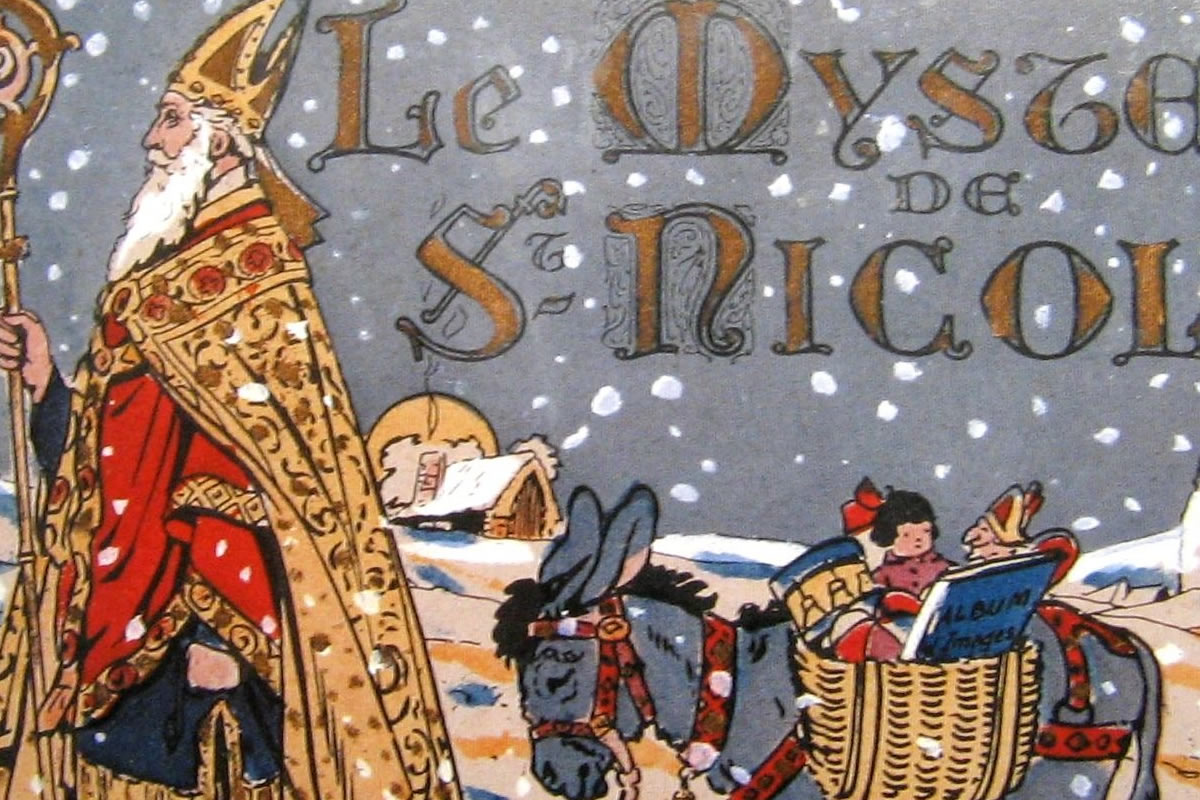

He died in AD343 and was buried in the cathedral church where he had held office. This might have been the end of the story, except that his reputation continued to grow after his death and his tomb became a popular place for pilgrimages. Reports spread of miracles happening to those visiting, until he started to be referred to as Saint Nicholas – though there is no record of his formal canonization. Subsequently, he was adopted as the patron saint of children and sailors, as well as unmarried people, repentant thieves and prostitutes!
His feast day on 6 December was celebrated in parts of Europe as early as the fourteenth century, and St Nicholas Day is still important in parts of Germany and the Netherlands. But this is still a long way from the jolly, sack-wielding figure who flies round the world on December 24. How did we get from St Nicholas to Santa Claus?
In 1810, The New York Historical Society commissioned an artist to create the first ‘American’ St Nicholas for its feast day dinner and the resulting picture was of a fatherly figure filling stockings hung over the fireplace. A few years later, the famous poem ‘The Night Before Christmas’ was published and described St Nicholas as ‘a right jolly old elf…dressed all in fur’. It also had him arriving in a ‘miniature sleigh and eight tiny reindeer’. In the mid-nineteenth century, an American cartoonist showed Santa living at the North Pole – a place of fascination at the time – and he never returned to Turkey! In the early twentieth century, he acquired his red, fur-lined suit, made more iconic when Coca-Cola advertisements started depicting him in red to match their brand. During this time, his name also underwent a transformation and the Dutch Santer Klause became the English Santa Claus.
While it might seem as though this figure has little in common with the saintly bishop on whom he is based, there are still some traces left. Just like Santa, Saint Nicholas is said to have carried out his acts of generosity under cover of darkness and the sacks full of toys seem to echo the sacks of gold left by the saint. Even the way Santa manages to reach all parts of the world in a single night suggests that like the saint he can perform miracles!
So when you fill the stockings and put out milk and cookies for Santa, you are in a way remembering the 4th-century bishop of a small town in Turkey. And that, in itself, is miraculous!
(Adapted from an article printed in Today’s Zaman December 24 2010)